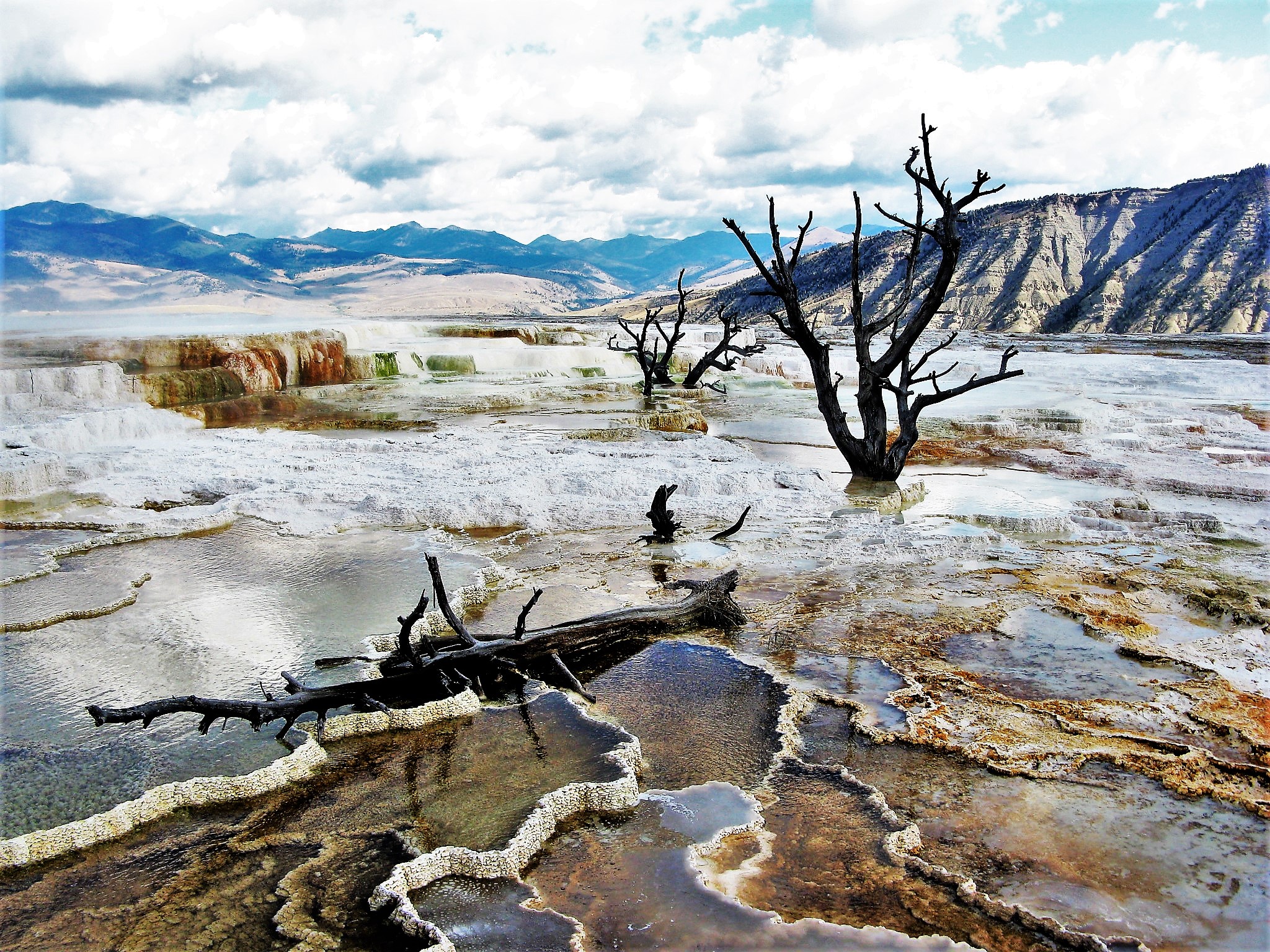
September 22 - October 6, 2009
I pulled into Bozeman with the idea
of staying one night in a motel before heading slowly back to
Seattle. Instead I had ANOTHER ACCIDENT! This one was a lot worse
than the first one. Some behemoth pickup just crushed my poor little
Yaris. No one was hurt, no damage to me except my psyche, which was
wounded; technically it was my fault (if true justice reigned I would
have been maybe 70% to blame) but my car took a beating. I had it
towed to the body shop where it would sit for nearly two weeks.
My
insurance covered a rental car, so now I was driving an unlikely red sporty thing. But the
run of truly great weather suddenly ended and a couple of days of
cold rain and snow left me stranded in a Bozeman motel. Bozeman wasn't bad. An old style downtown that's hanging in there: hardware store,
shoemaker, camera store. Not many towns have any of these anymore. I
spent a good amount of time in Lindley Park where the snow was very
pretty. But September?
Eventually
I set off for Headwaters State Park, where the Jefferson, Madison,
and Gallatin Rivers converge. It was a disappointment. For such a
significant site, the state hasn't done much with it.
So
I drove down Gallatin Canyon, a lovely strip hard to enjoy at the 60
MPH speed limit traffic forced me to maintain. The highway cuts into Yellowstone for a while,
dropping the speed limit a bit and providing wonderful river meadows
but no facilities before reentering national forest. I detoured up
the Hebgen Lake/Earthquake road only to find the visitor center
closed. Interesting scene though. Scarp viewpoint along the way. You
hear the word and probably pass loads of them so this is cool to look
at. It is just a natural wall-seeming hill that before the earthquake
was no hill at all. One side fell, the other rose.
 |
Gallatin River
|
 |
earthquake scarp
|
Down
in West Yellowstone I bumped into Bob Anderson again. He rebutted the
report I had heard, that a 20,000 northern elk herd had been reduced
to 4,000 since the reintroduction of the wolves. The highest elk
count he’d ever heard was 13,000 while the 2008 count was 9,000. He
also noted that wolves take the oldest and the youngest of the herd
while hunters take those in their prime, asking rhetorically which is
doing the most damage.
Island
Park seemed dreadful despite its good moose habitat. I noted a sign
for the “Asbestos Mine Trailhead” before proceeding down the Mesa
Falls Scenic Byway, little more than the two Mesa Falls though they
are terrific. Upper Mesa Falls is 114’ high, “the largest
undisturbed waterfall in the entire Columbia River system“
according to the sign on duty. Wide and powerful. A heavy-duty
staircase takes visitors down alongside the falls, but a straight
shot is impossible. The trail does provide a real view of the river
just before it makes its plunge though. Lower Mesa Falls requires a
little adventure to see up close, and I negotiated some tricky
footing without incurring more stigmata. The lower falls is 65’
high, more narrow than the upper falls and much wilder.
 |
Snake River
|
 |
Upper Mesa Falls
|
 |
Snake River
|
 |
Lower Mesa Falls
|
 |
Lower Mesa Falls
|
The
river was running strong even this late in the season thanks to Big
Springs, “one of the largest freshwater springs in North America.
Approximately 120,000,000 gallons of water at 52 degrees Fahrenheit
flow from the spring daily”, thus quoth an interpretive sign at
Upper Mesa Falls.
This
was the Henry’s Fork of the Snake River. Andrew Henry, says a trail
sign, was a trapper here in 1810-12. I thought that seemed awfully
early to be way out here, hot on the heels of Lewis and Clark, and I
wondered why I’d never heard of him. I felt somewhat exonerated
when I later read Robert Utley call Henry “one of the most
successful yet least recognized explorers of the northern Rockies.“
Henry
in fact worked for Manuel Lisa, who launched the first organized
trapping expedition from St. Louis in the wake of Lewis and Clark’s
return. Henry had set out to trap near Three Forks on the Missouri
but the Blackfeet wouldn’t have it and drove Henry and his men
right out of the watershed, up the Madison and over the Continental
Divide on a low pass later known as Raynolds Pass and down into the
upper Snake. They built the very first settlement west of the Rockies
(well, Astoria…?) and endured one very rough winter there before
retreating back east. This was the same trip in which John Coulter
wandered through the region’s now renowned thermal features, his reports
basically dismissed as fantasy for quite some time.
 |
Snake River
|
Back
at the Grand View Campground it was just me and one other car on a
warm Saturday night under a half moon. The other car left early
Sunday morning and I was alone, singing "Racing in the Street",
a reflection of my dolorous spirit. I almost decided to drive down
the road to the Bechler River entrance, a corner of the park I'd yet to visit, but I wimped out. I drove
instead through some of the Idaho towns that had sounded interesting
in the guide book but weren't so good on the ground. I passed through
St Anthony, which I later learn is the approximate location of Henrys
Fort.
I
ended up back on the Snake, at the Palisades Campground. Sunny, breezy, and
mild, shade when I needed it, sun on the banks when the sun got low
enough. This visit I secured a riverfront site. Looking into the
middle distance, at golden aspen glowing in the hazy afternoon sun. I
will surely miss gazing into the middle distance, won't I? I spent much
time reading the handouts on the Teton River and fishing, but will
spare you my findings this late in the journey.


 |
Grand Teton - Mount Moran
|
Back
at Grand Teton, the trees were on fire, whether wild or prescribed I wasn’t
sure. In either case the forecast called for snow. On to Bozeman and
an empty motel, promising quiet and assuring an easy walk to the fine
Bozeman Library. The next morning I found some itchy welts on my arms
and legs. Too cold for mosquitoes I thought. The next night I turned
on the light in the middle of the night and saw a large bug scurrying
across the sheet. I thwopped it and it oozed blood, presumably mine.
This perhaps explained why the motel was empty. I relocated to a
nicer one with free wi-fi, rented a laptop, and spent the early fall
snow storm uploading pictures and streaming NPR.
Finally
my car was ready, with repair costs over $4500 on a $13,000 car. I
though I might stay in town another night but the body shop owner
dissuaded me. A bigger storm was coming in and I might not have made
it out of Bozeman if I waited. So I left early afternoon and made it
to Missoula. The roads were all ice the next morning so I had to wait
for things to warm up before heading out. Next stop Spokane. Stop
after that, Seattle. It was all over. I’m feeling sad just thinking
about it.
That,
in a nutshell, is my story. Yours?